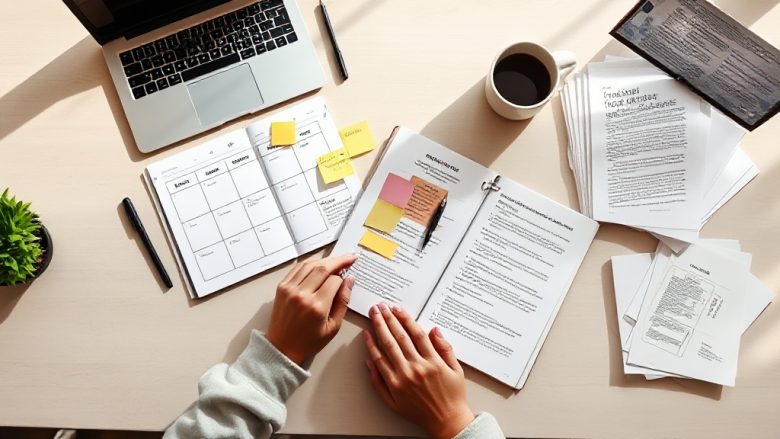
Open your drafts folder. Be honest about what’s in there. Three openings with no middle, a half-finished listicle from spring, a voice memo you transcribed and never touched again. Most people don’t have an idea problem. They have a finishing problem, and the gap between the two is almost never motivation. It’s process. This step by step guide to content creation is built for the person who writes between a commute and a laundry pile, because a pipeline that only works on calm weeks isn’t a pipeline at all.
I’ve been publishing while holding down a full-time job for years now, and the weeks I shipped weren’t the weeks I felt inspired. They were the weeks the system did the deciding for me. What follows is that system, broken into stages you can run in about five hours a week once it’s warm.
Why Ideas Aren’t Your Problem
An abandoned draft feels like evidence of laziness. It usually isn’t. It’s evidence that you tried to do four jobs at once: think of the topic, structure it, write it, and polish it, all in one sitting, probably on a Tuesday night when your brain was already done for the day.
Every stage of creation uses a different kind of attention. Generating ideas is loose and associative. Drafting is fast and messy. Editing is slow, critical, and slightly mean. When you stack them, the critical voice wakes up while the associative one is still talking, and the draft dies mid-sentence. Separating the stages is the entire trick. You’re not becoming more disciplined. You’re just refusing to multitask.
One more thing before the steps: pick a container. A single notes app, a spreadsheet, a paper notebook. It doesn’t matter which. What matters is that every idea, fragment, and complaint lands in the same place, because a pipeline with four entry points has no entry point.
Step 1: Capture Ideas Before They Evaporate
Ideas show up at bad times. In the shower, mid-meeting, while you’re explaining something to a colleague and hear yourself say something worth writing down. The capture stage exists to catch those moments without asking you to develop them yet.
Keep the bar embarrassingly low. A phrase is enough. “Why my batch cooking fails by Thursday” is a complete capture. You are not solving the idea, you’re tagging it for later. I keep a running note on my phone and add two or three lines a week, usually complaints, questions people ask me, or things I had to figure out the hard way.
Once a week, empty that note into your main list and add one line to each idea: who it’s for and what they’d get from it. If you can’t fill in either line, the idea isn’t ready. Leave it in a parking lot section rather than deleting it. Some ideas need six months to ripen, and that’s fine.
Two sources keep the list alive when inspiration is dry. First, questions you’ve been asked more than once, since repetition means an audience exists. Second, problems you solved in the last month, because you still remember the details that make a piece useful rather than vague.
Step 2: Plan the Piece Before You Write a Word
Planning is where most stalled drafts could have been saved. Ten minutes of structure prevents an hour of wandering.
For each piece you’re ready to write, decide four things. The single point it makes, in one sentence. The reader it’s for. The shape it takes, whether that’s a walkthrough, a comparison, or a story with a lesson. And the rough order of its sections, written as plain headings rather than polished prose.
That one-sentence point does more work than anything else in this guide. If you can’t state it, you don’t have a piece yet, you have a topic. Topics produce meandering drafts. Points produce finished ones.
Give the plan a time box. Fifteen minutes, timer on. When it rings, stop planning even if the outline is imperfect, because planning is the most comfortable stage and comfort is how weeks disappear. A decent outline you start writing beats a perfect one you admire from a distance.
If a piece keeps resisting structure, that’s useful information. It might be two pieces wearing one coat. Split it and suddenly both halves write themselves.
Step 3: Draft Fast, Edit Slow
Drafting and editing are different jobs, and doing them in the same session is why your inner critic keeps winning.
When you draft, you write to the outline and you do not stop. No rereading the previous paragraph. No hunting for the perfect word. If a fact needs checking, drop a marker in brackets and keep moving. Typos survive on purpose. The goal is a complete, ugly version of the piece, because a finished rough draft can be fixed and a beautiful fragment cannot.
Editing comes later, ideally on a different day, and it runs in passes rather than one heroic sweep. First pass: structure. Does each section earn its place, and does the order carry the reader forward? Cut whole sections here without mercy, since a section that doesn’t serve the point is weight, not value. Second pass: clarity. Tighten sentences, replace vague claims with specifics, and read the piece aloud to catch the places where you’d stumble. Third pass: mechanics. Grammar, spelling, formatting, and the small consistency checks that make a piece feel professional.
One habit matters more than any editing trick: put at least a few hours, preferably a night’s sleep, between drafting and editing. You cannot see your own writing clearly while you still remember what you meant to say. Distance is the cheapest editing tool you own.
Step 4: Publish on a Schedule, Not a Mood
Publishing is a decision, not a feeling. If you wait until a piece feels ready, ready will keep moving.
Define what done means for you and write it down. For most pieces it’s something like: the point is clear in the first few lines, every claim is either specific or removed, the formatting is consistent, and it has a title that tells the reader what they get. When those boxes are ticked, it ships. Not perfect. Shipped.
Pick a cadence you can hold on your worst week, not your best one. Once a week is plenty. Once every two weeks is also plenty. What kills momentum isn’t a slow schedule, it’s an unpredictable one, because readers can’t build a habit around a maybe.
Then close the loop with a short review. Note what you published, how long each stage took, and where you got stuck. After a month you’ll see your own pattern: maybe planning eats your time, maybe editing always drags. That pattern is the only productivity advice worth following, because it’s based on your actual weeks rather than someone else’s ideal ones.
Batching: The Only Way This Survives a Busy Week
A pipeline that runs one piece at a time is fragile. One bad week and it collapses. Batching fixes that by grouping similar work together.
The version that works for me looks like this. Monday evening, twenty minutes: capture and pick the next piece. Tuesday, thirty minutes: plan it. Wednesday and Thursday, forty minutes each: draft. Friday, thirty minutes: edit a piece planned the previous week. Saturday morning, twenty minutes: publish and review. That’s roughly three hours, and the stages never compete for the same mental energy.
If you’d rather compress, block two hours on a weekend and run capture, planning, and drafting back to back, then edit midweek. Either way, the principle holds: group similar tasks, and always keep one piece in the pipeline ahead of the one you’re publishing. A small buffer of a single planned draft is the difference between a busy week slowing you down and a busy week ending the streak entirely.
Measure What Worked Without Obsessing Over It
Numbers are useful in small doses and corrosive in large ones. You’re looking for signals, not a scoreboard.
Track three things per piece: how many people finished it, how many responded in some way, and how long it took you to make. Finished reads tell you whether the opening delivered on its promise. Responses tell you whether the piece was worth someone’s attention. Time tells you whether your process is getting smoother or quietly bloating.
Once a month, look for repeats. A topic that drew responses twice is a direction. An opening style that keeps losing readers is a habit to drop. Then change one thing, not five, and give it a few pieces before judging. Most people quit a promising format after a single quiet post, which is like abandoning a recipe because one dinner guest wasn’t hungry.
Ignore vanity numbers that don’t connect to anything you care about. A big number that doesn’t lead to a conversation, a subscriber, or a returning reader is entertainment, not feedback.
Keeping the Loop Alive When Life Gets Loud
The graveyard of drafts isn’t a character flaw. It’s what happens when creation depends on free time and willpower, both of which are unreliable roommates.
So build the loop to survive interruptions. Keep the idea list stocked, since capture is the one stage you can do in thirty seconds. Keep one planned draft waiting, so a chaotic week doesn’t leave you starting from zero. And when you miss a week, and you will, resume at the next scheduled stage instead of restarting the whole thing. A pipeline’s value isn’t in never breaking. It’s in being easy to restart.
Do this for two months and something shifts. You stop waiting to feel like writing and start showing up because it’s Wednesday and Wednesday is drafting day. The drafts folder, meanwhile, quietly empties out, one finished piece at a time.